
From Empty Stands to 10 Million Viewers: Baseball’s Unlikely Comeback with the 2026 World Baseball Classic
By Bianca Peralta | 14 April, 2026
A few years ago, baseball was the sport everyone agreed was dying.
The arguments were all too familiar: games were long, the pace was glacial, the culture was stiff. From 2016 to 2022, MLB's World Series viewership fell by more than half while the average age of its viewers continued to creep into the late 40s. Meanwhile, the NBA was minting global superstars. LeBron James and Stephen Curry weren't just athletes, but were cultural phenomena. Their faces were plastered all around the media whether that was being featured in commercials, on billboards, and, more importantly, in online content. Their highlights looped endlessly on cellphones belonging to teenagers all across the world and brought about a buzz never before experienced. Baseball, by contrast, felt like something your grandfather watched on the sofa half-asleep.
What nobody predicted was that baseball would actually listen and reform.
The Crack in the Foundation
Baseball's decline wasn't sudden. It was the slow erosion of a sport that had mistaken tradition for identity.
For most of the 20th century, baseball genuinely was America's pastime — not just as a marketing phrase, but as lived reality. It carried the country through the Great Depression and two World Wars. Babe Ruth was the first athlete to be truly famous in the modern sense of the word: his face plastered on products and his name recognizable to people who had never seen a game. Jackie Robinson's arrival in the major leagues in 1947 made the sport a staging ground for civil rights history. By mid-century, baseball wasn't just popular; it was woven into the fabric of how Americans thought and spoke. "Step up to the plate." "Out of left field." "Touch base." These phrases and so many more became common American vernacular. The sport had colonized the language itself.
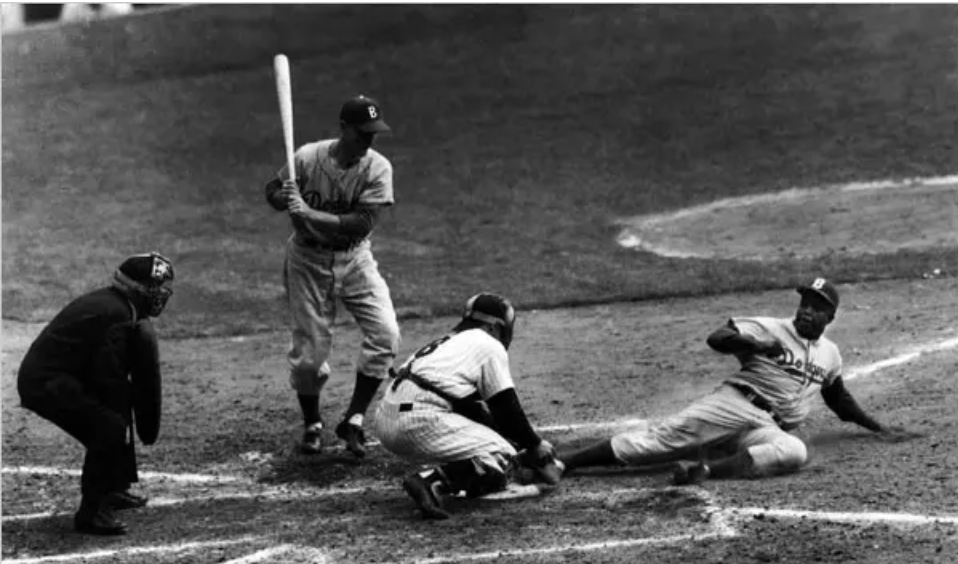
Jackie Robinson slides home beneath Yogi Berra’s tag in the eighth inning of Game 1 of the 1955 World Series at Yankee Stadium. (John Rooney/Associated Press)
But the culture shifted, and baseball didn't shift with it. By the late 2010s, the problems were structural, integrated deep within the workings of the sport. The average game crept past three hours. Between-pitch pauses stretched on and plagued the pace-of-play. Defensive shifts drained action from the field. The sport that had once thrived on improvisation and instinct had become almost too optimized for entertainment, offering no room for spontaneous enjoyment.
Frowning upon intense emotions and self-expression among players, baseball's unwritten rules also greatly impacted the disconnect felt by younger fans to the aging sport. Players who celebrated too visibly with a bat flip after a massive home run or a fist pump on the mound risked the label of being "disrespectful." This provided the allure of José Bautista's bat flip in the 2015 ALDS against Texas — a moment that, just 11 years ago, ignited a firestorm that would seem almost unthinkable today, when it's hard to sit through a single inning without seeing a spinning bat flip, a home run trot with a little theater, or a dugout eruption that would have made the old guard wince.
Becoming one of the most discussed moments in recent baseball history, the flip was not only iconic, but it also dared the boundaries of before. The fury that it invoked revealed the insularity that so deeply plagues the culture of baseball to the point that a player celebrating one of the biggest moments of not just his career, but also Blue Jays history, had become a national debate.
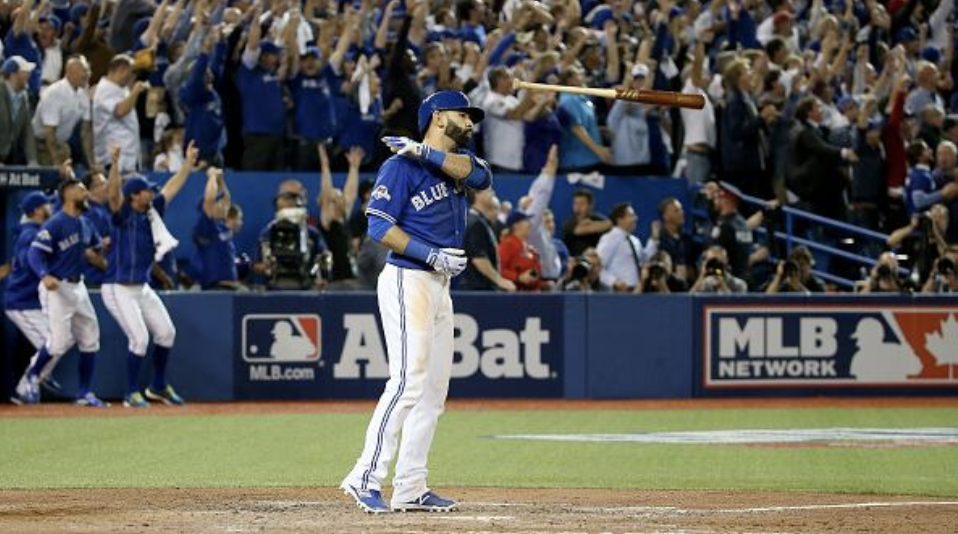
José Bautista unleashes his iconic bat flip after a go-ahead home run in Game 5 of the 2015 American League Division Series. (Tom Szczerbowski/Getty Images)
Meanwhile, the NBA let its stars be human. LeBron laughed, pointed, stared down opponents. Steph Curry smiled after threes like he was in on a joke. The contrast was stark.
The Fixes That Actually Worked
When MLB announced its plan to implement the pitch clock before the 2023 season, the reaction was mostly of skepticism and hesitancy. Players grumbled, while traditionalists of the game predicted chaos. But the results spoke for themselves, with games becoming 25 minutes shorter on average and satisfaction among fans growing. The pace just felt better, more urgent and less like waiting.
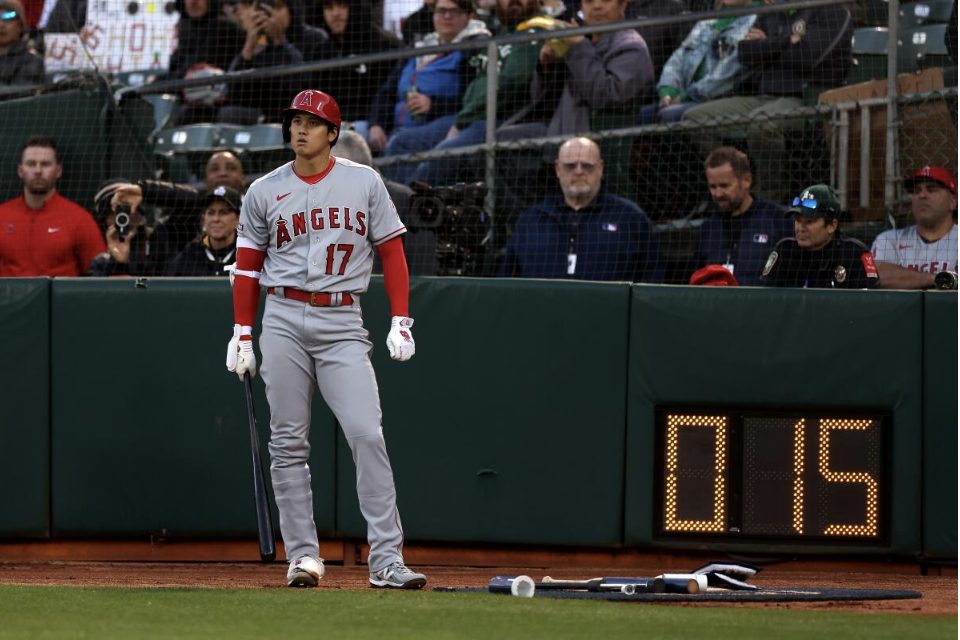
Shohei Ohtani waits in the on-deck circle beside the pitch clock on Opening Day 2023 against the Oakland Athletics. (Ezra Shaw/Getty Images)
The shift restrictions also brought balls back into play. Larger bases encouraged stolen base attempts. The game's fundamental tension — pitcher versus hitter, speed versus instincts — became legible again. In 2023 alone, stolen base attempts jumped by 30%, which doesn't sound like a culture change until you watch a game and feel the difference when there's a runner on first who might actually make a move towards second.
But the rules were only part of it. The more significant shift was human.
Shohei Ohtani was doing something that hadn't been done seriously since Babe Ruth — pitching and hitting at an elite level simultaneously — and doing it with a focused and almost extraordinary calm that translated globally. Beyond his home country, his appeal swept across the entire globe. Ohtani quickly became a household name, even in the non-baseball households, with casual fans tuning in just to see what he's capable of doing next. His 2023 MVP season, headlined by 44 home runs and 167 strikeouts as a pitcher, was a reminder that baseball could still produce figures whose greatness defied borders and categorization.
On a different note, Fernando Tatis Jr. represented something else: the game's permission to perform. A Tatis home run didn't end with a quiet trot. It ended with an expression. Baseball was starting to look like it was being played by people who unforgivingly and undeniably enjoy it.
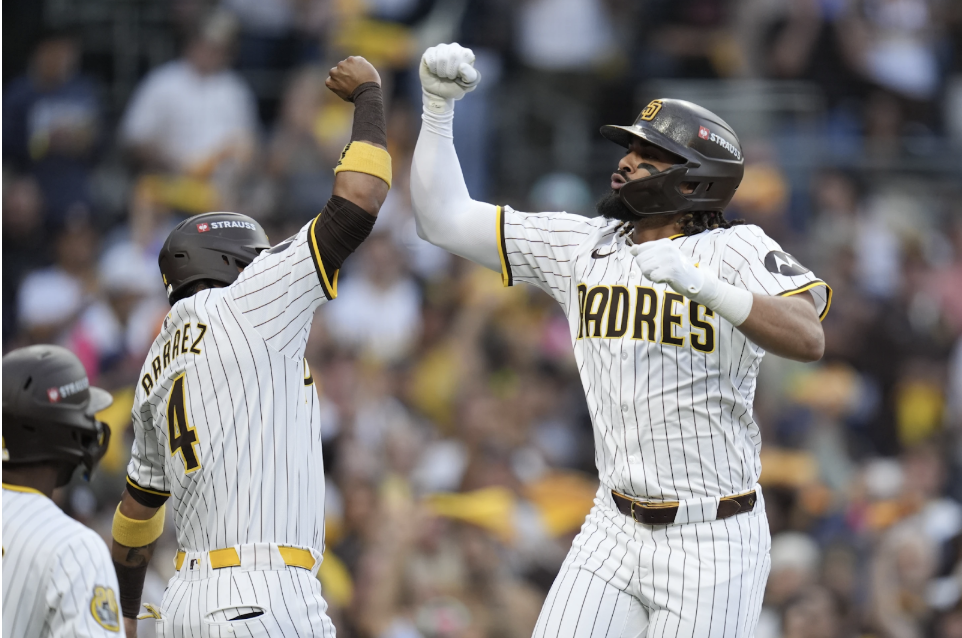
Fernando Tatis Jr. celebrates with Luis Arraez after a two-run homer in Game 1 of the 2024 NL Wild Card Series against the Atlanta Braves. (AP Photo/Gregory Bull)
The energy spread beyond the batter’s box as well. When Edwin Diaz jogged out of the New York Mets’ bullpen to the live blare of Timmy Trumpet’s saxophone, an entire stadium transformed into something that felt closer to a concert arena with flashing lights than a baseball game. What was once a quiet and functional part of the sport, closer entrances had now become their own event. Baseball was finding new ways to be theatrical and fun, and fans were showing up for all of it.
By 2025, MLB.TV viewership among fans 17 and under had grown by 66%. Social media was an integral part of this growth — walk-off home runs being clipped and shared, celebration videos going viral — but so did the simple fact that the games themselves were more entertaining.
The WBC and the Thing Baseball Had Been Missing
All of this set the stage for 2026. But the World Baseball Classic isn't just a symptom of baseball's revival. It's the proof of concept.
The WBC was first held in 2006 with the modest ambition of creating a showcase for international talent. For years, it remained a second-tier attraction, undercut by Olympic baseball alongside the reluctance of MLB teams to risk injuries to their players during spring training. But the 2023 edition, which was held after a pandemic-delayed cycle, broke through. Japan's run to the championship, punctuated by Ohtani's game-sealing strikeout against Mike Trout with the title on the line, produced one of the most genuinely electric sports moments in years.
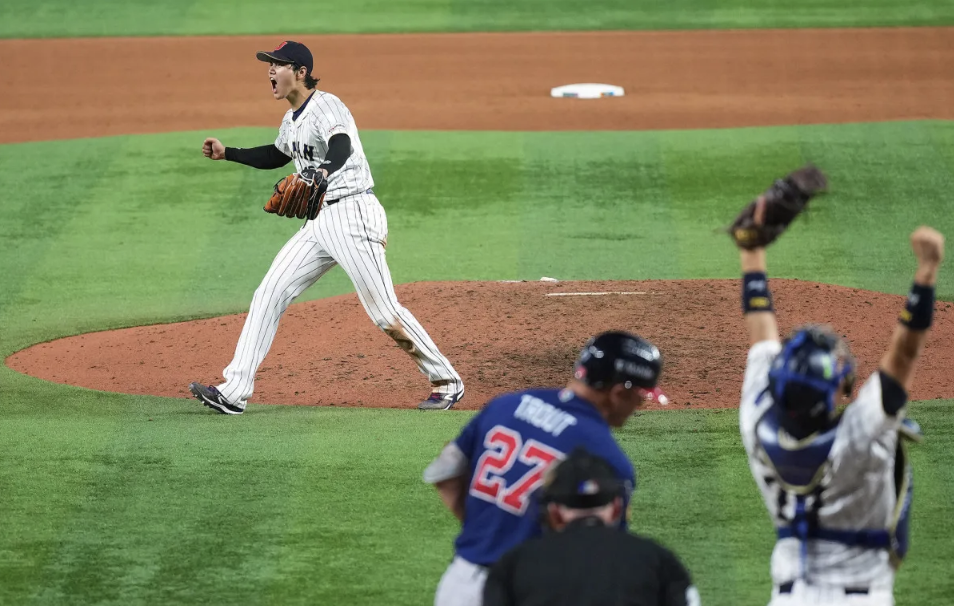
Shohei Ohtani shouts in celebration after striking out Mike Trout to clinch Japan’s World Baseball Classic title. (Samurai Japan/Getty Images)
The WBC creates an atmosphere that regular season baseball almost structurally cannot. When Taiwan beats South Korea in pool play to stay alive in the tournament, the dugouts don't restrain themselves. When Venezuela's players mob each other after a walkoff, nobody questions whether that's appropriate. The passion isn't incidental to the WBC but, instead, the entire point of it all.
The 2026 tournament has expanded that scope further, spreading games across four stadiums in different countries. The Italian squad, a perennial source of the WBC's best subplots, showed up this year with the kind of chaotic energy that makes the tournament intriguing at the very least. Naturally, it involved a very serious team ritual surrounding an espresso machine in the dugout and players drinking home run espresso shots. Venezuela's run through the bracket has also electrified a fanbase that experiences the sport with an intensity that doesn't always translate through a television screen, and yet it still did.
Venezuela's 3-2 victory over Team USA in the championship game drew an average audience of 10.784 million viewers on FOX, making it the most-watched WBC telecast in tournament history. The 2026 Classic also saw a 156% increase over the 2023 edition, averaging 1.294 million viewers across FOX, FS1 and FS2.
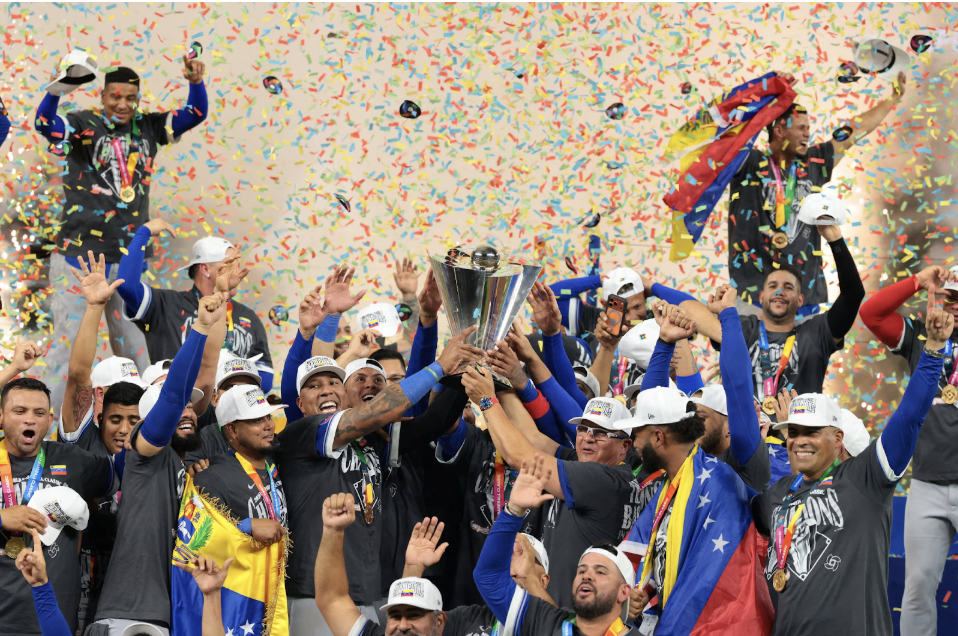
Team Venezuela celebrates on the stage after defeating the United States in the 2026 World Baseball Classic championship game at LoanDepot Park. (Sam Navarro/Imagn Images)
What the WBC does, more than anything, is make the stakes feel real, not pennant-race real, but something older and deeper. It runs on national pride, identity, and the sense that what's happening on the field matters beyond standings.
What It All Adds Up To
Baseball's recovery didn't happen because MLB ran a clever marketing campaign. It happened because the sport made concrete, specific changes — to the rules, to the culture, to who it let itself be — and then the world gave it credit for them.
The 2026 World Baseball Classic is the clearest expression yet of what baseball looks like when it's fully embracing itself and its quirks of being technically demanding, emotionally alive, and genuinely global. The tournament draws on talent from countries that have their own deep baseball traditions — Japan, the Dominican Republic, Venezuela, South Korea — and amplifies them on the world’s center stage. The sport that once exported itself as purely American has now become a shared language that different cultures speak in different accents.
None of this means baseball's problems are solved permanently. But the question isn't whether baseball is dying anymore. The question now is how far it can actually go.
