
Pushing the Limits: High Prices and the Expanded World Cup
By Noah Massey | 4 May 2026
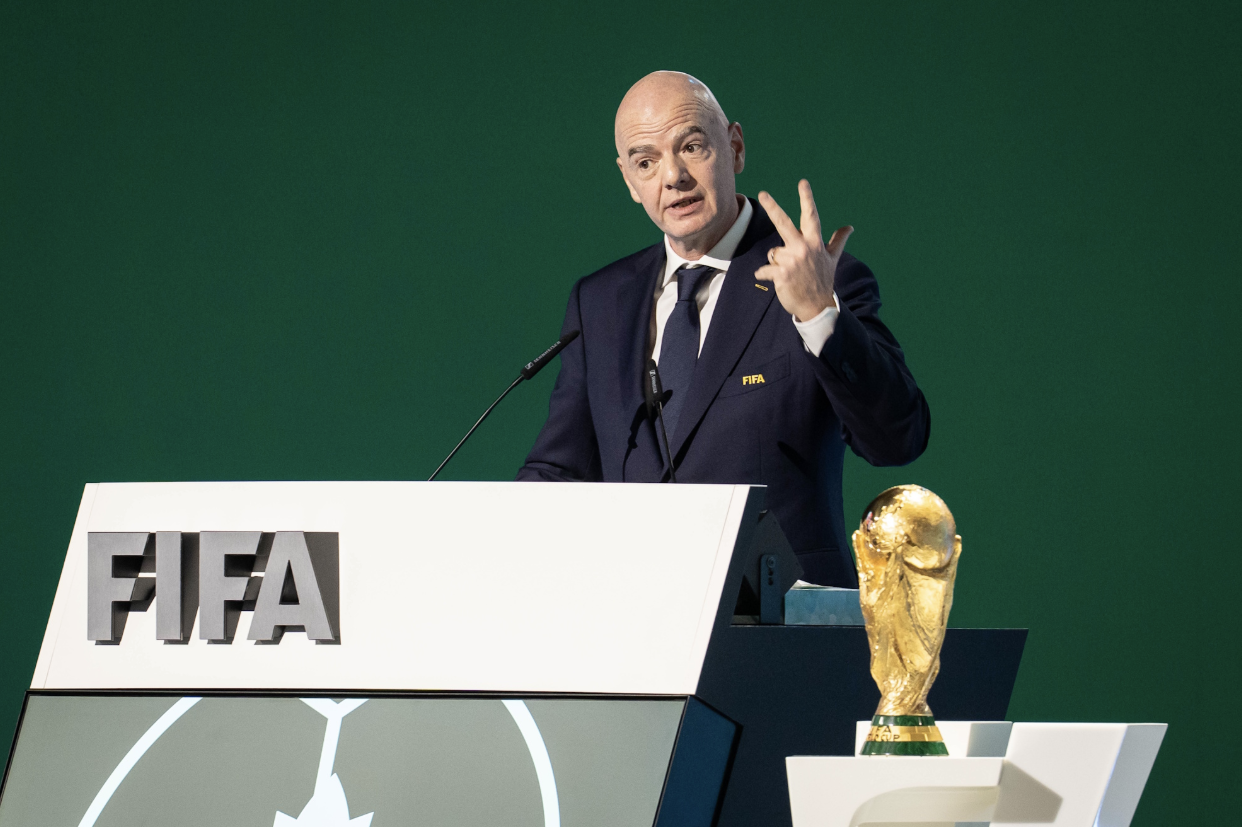
FIFA president Gianni Infantino defends World Cup pricing at a pre-tournament event (MARCA)
What happens when one of the largest tournaments in the world, run by an already-controversial organization, collides with notoriously high American live event costs?
For anyone familiar with the difficulty of acquiring tickets to major U.S sports events, the result has been exactly as expected.
FIFA has played directly into the bold assumptions surrounding the American consumer, asking the question of exactly how much people might pay to attend the greatest spectacle in sports, despite the spectacle undergoing significant changes and the ongoing controversy that has surrounded the tournament, its leadership, and the leadership of the nations hosting it.
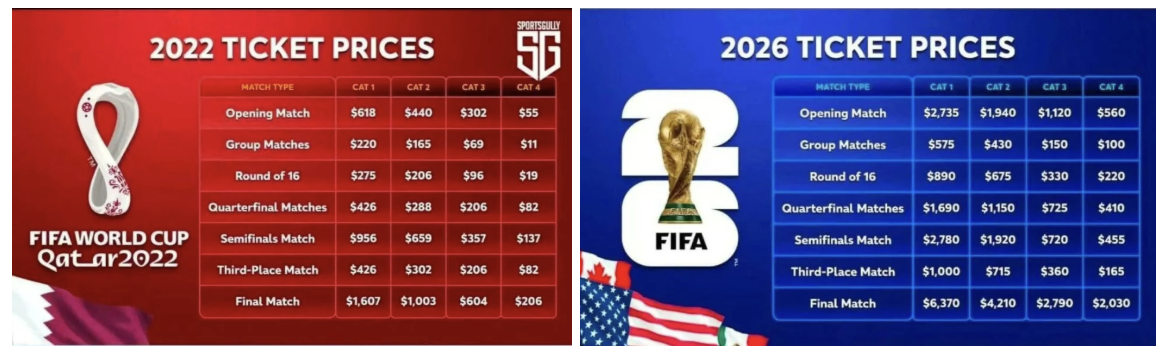
A comparison of initial ticket prices for the 2022 and 2026 World Cup. (SportsGully)
Setting the Scene:
The 2022 World Cup in Qatar cemented the tournament as the most-watched sporting event in the history of the world, bringing in an astounding five billion unique viewers from around the world, according to FIFA’s website. Furthermore, the non-profit also posted a 96.3% stadium occupancy rate as 3.4 million spectators viewed the tournament in-person despite it being hosted in Qatar, which was the source of plenty of criticism prior to the tournament.
With the success of the previous tournament in tow, FIFA has transformed its primary money-making source by adding more teams and more games, a move that will boost attention from even more countries and give more opportunities for the organization to reap even more profits from its quadrennial spectacle.
FIFA’s attempts to capitalize on the tournament have spread beyond the tournament’s structure. Between ticket and parking pass costs that have dwarfed previous world cups, FIFA has made it quite clear to fans that it believes the spectacle will have enough demand regardless of the sky-high prices.
This belief has made itself increasingly obvious in the year leading up to the tournament. Before even releasing ticket prices, FIFA announced that it would be using demand-based dynamic ticket pricing for the first time. While this has been used for years for other live events, including sports, FIFA’s system was unique in that the dynamic pricing wasn’t for seats. It was to be seated in stadium category “zones,” where a given ticket in category 1 could be a sideline spot at the 50-yard line or it could be a corner seat on the second deck.
The two most expensive zones, Category 1 and Category 2, vastly outnumber the Category 3 and especially the tiny areas meant for Category 4 tickets – which are for official supporters’ clubs and are listed for far less than other tickets.
To make matters even worse, The Athletic has reported that FIFA has changed maps following ticket purchases – forcing fans who splurged on Category 1 tickets to find out that they were banished to locations they didn’t even think possible far above the goal line or closer to the less-desirable stadium corners – and allocated a high majority of Category 1 tickets to the worst possible zones, as the best Category 1 sections noted on the map will be largely filled with the ultra-expensive hospitality tickets.
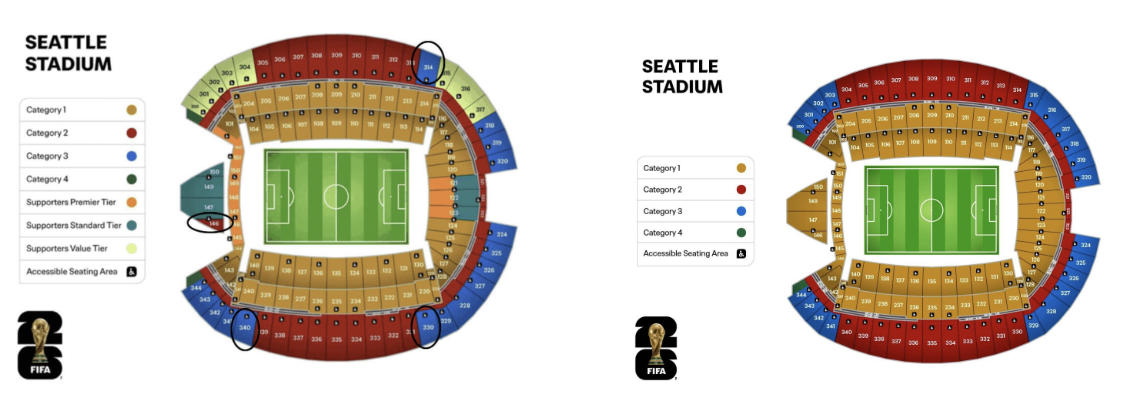
Fifa’s initial Seattle Stadium map compared to the one currently listed on their website (The Athletic)
Since then, FIFA has also introduced “Front Category 1” and “Front Category 2” tickets, which guarantee a buyer a spot at the bottom of the zone. They are listed at twice the price as normal Category 1 and Category 2 tickets.
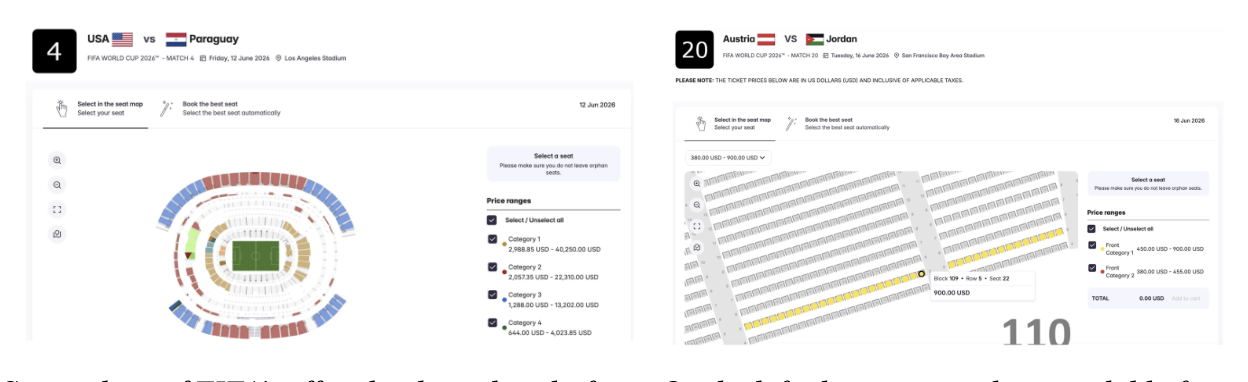
Screenshots of FIFA’s official ticket sales platform. On the left, the current tickets available for resale indicate that most of the ticket allocation for Category 1 were in the least desirable areas of the stadium. On the right, the newly released Category 1 Front tickets are shown. (The Athletic)
On the parking front, parking passes have reached up to $300 – a devastating blow for any fans trying to get to stadiums that are surrounded by parking lots and are located far outside of city centers. Even public transport options have been affected – a round-trip train ticket from New York City to MetLife Stadium in New Jersey has been listed at $150, a tremendous increase from its usual price of $12.90.
Just the World Cup itself is going to be extraordinarily expensive for all visitors, not even factoring travel costs and hotel costs, which will certainly be raised on dates surrounding tournament dates. For many prospective visitors, the question might emerge: Is attending the World Cup worth it?
Ramifications:
It’s impossible to judge how much these price hikes will actually affect the tournament, at least for now. Plenty of controversy surrounded both of FIFA’s last two spectacles – which were hosted by Russia and Qatar – and both tournaments still had tremendous attendance and enthusiasm around the tournament.
While it is likely that the 2026 tournament hosted by the United States, Mexico, and Canada will be the same, there is cause for concern that the spectacle might fall short in ways previous tournaments have not. Firstly, the new tournament structure will likely limit early-round drama, with eight of the 12 third-place teams from the initial four-team groups moving on to the knockout stage. This problem might be further exacerbated by the poor quality of many of the tournament’s worst teams.
Though it was an amazing story for many of these countries to make the tournament, it might be tough to watch Germany, Ecuador, and Cote d'Ivoire repeatedly body-slam Curacao in the group stage, helping to ensure that all three nations are almost guaranteed to advance to the knockout stage.
To make matters worse, Cote d'Ivoire – along with Iran, Haiti, and Senegal – are all participant nations, which are directly affected by the U.S. travel ban. Increased U.S. border control and visa measures will make entering the country more difficult for fans from other nations as well.
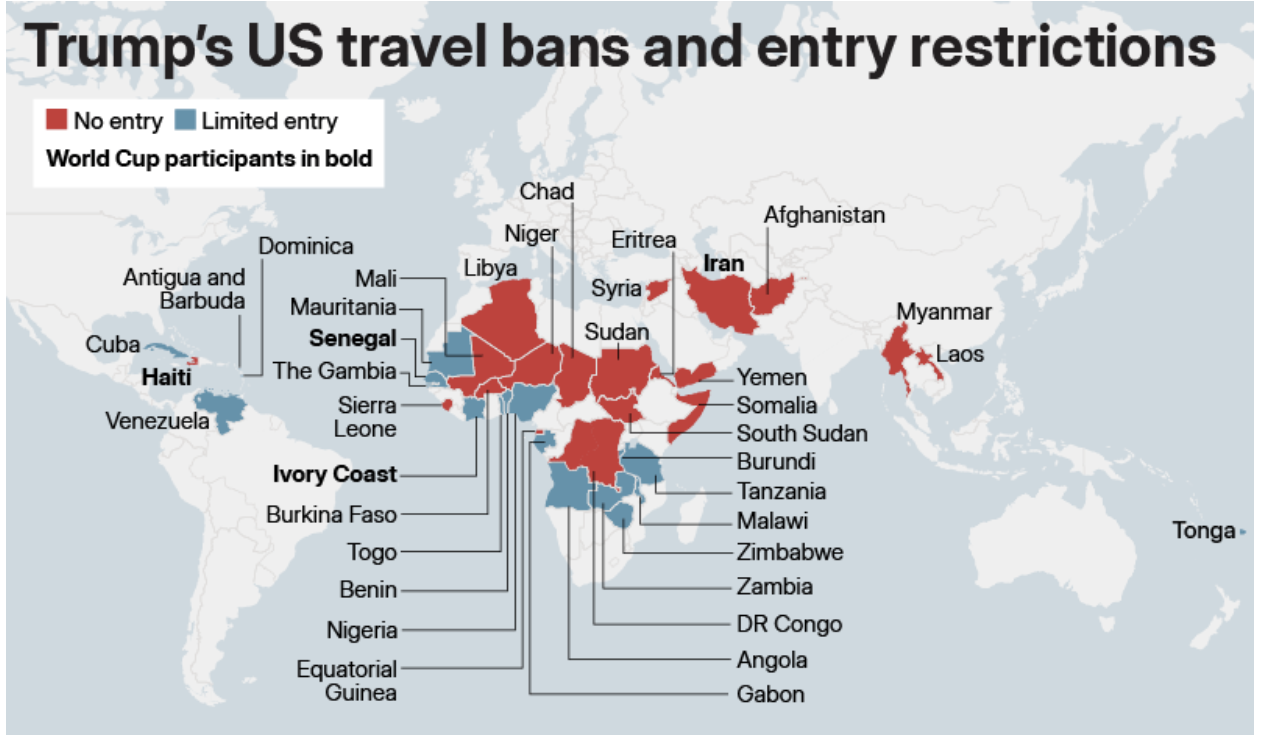
Beyond the nations fully restricted from entering the U.S, multiple other World Cup participant nations also face entry restrictions. (The National News)
Despite the United States’ prominence as a well-known tourist destination with tremendous enthusiasm for sport – especially when compared to Russia and Qatar – higher costs, a new format, and travel restrictions might have a significant impact on the world-renowned tournament and could put a damper on the U.S’s global reputation as a future host for international competitions.
While demand for viewing sports has never been higher and it is likely that the World Cup will take over the world once again, the exorbitant costs might also have other long-term implications. The tournament will provide a fantastic opportunity to grow the sport in the U.S., but with current prices, it is proving increasingly likely that many die-hard fans and families will be priced out of the event. Those fond memories of going to the game that might last forever and help create lifetime fans will be impossible for Americans and visitors alike with the current prices.
While the World Cup is a profit-generating event and FIFA is a business in the end, the realities that the 2026 World Cup has revealed – that FIFA can simply say what it wants and post egregious prices due to the tremendous demand – showcases a dark future for major athletic events and the countless people who will miss out on the opportunities to experience them. It also creates even more distrust in FIFA regarding ticket transparency and a fair ticket allocation process, a distrust which has been building for years with ticket release strategies, but has never been as blatantly misleading as it is today.
