
By Aaron Propst | 2 November 2026
It’s 1973, and Major League Baseball faces its first lockout in league history.
Just one year removed from the league’s first players' strike, tensions between team owners and the Major League Baseball Players Association have reached another breaking point. With the previous collective bargaining agreement expired, the two sides remain divided over salary arbitration. This resolution process would allow eligible players to challenge their salaries before an independent arbitrator, rather than accept the figures determined by their team’s front office..
On February 8th, owners shut down early spring training camps, beginning a seventeen-day lockout that threatened preparations for the upcoming season. The dispute ended on February 25th, when both sides agreed to a new three-year collective bargaining agreement that established salary arbitration for eligible players. Although no regular-season games were lost, the confrontation marked the beginning of a decades-long struggle over money, power, and control in professional baseball.
The agreement established a precedent that would reshape the relationship between professional athletes and their team’s owners. Owners had exercised overwhelming control over player salaries and working conditions for decades. Collective bargaining proved that players could unite to challenge ownership and secure greater influence over their careers. This compromise marked a shift in professional sports, setting a precedent that owners could no longer dictate employment terms without facing organized resistance from the athletes themselves.
It is now the year 2026, and anticipation of another lockout is on the horizon. But why this time?
At the center of this dispute is a proposed salary cap, which would limit how much teams can spend on players. Owners have reportedly pushed for a $245.3 million salary cap alongside a $171.2 million salary floor, arguing that the restrictions would improve competitive balance and generate more parity in the league. The players' union opposes the proposal, arguing that a cap would suppress salaries and limit players' earning potential.
Yet, the disagreement extends beyond player salaries: Owners have pointed to a payroll gap exceeding $400 million between the league's highest and lowest-spending teams as evidence of financial inequality. The union, however, argues that smaller-market teams often choose not to invest in talent despite increasing revenues.
“I am not, by nature or sort of intellect, a deadline bargainer. I think in recent years it has become more deadline-driven, which is not uncommon,” said MLB Commissioner Rob Manfred. “We want to play in 2027."
If the two sides fail to reach an agreement before the current CBA expires, owners could initiate a lockout to gain leverage in negotiations.
And at the center of this entire controversy is the Los Angeles Dodgers.
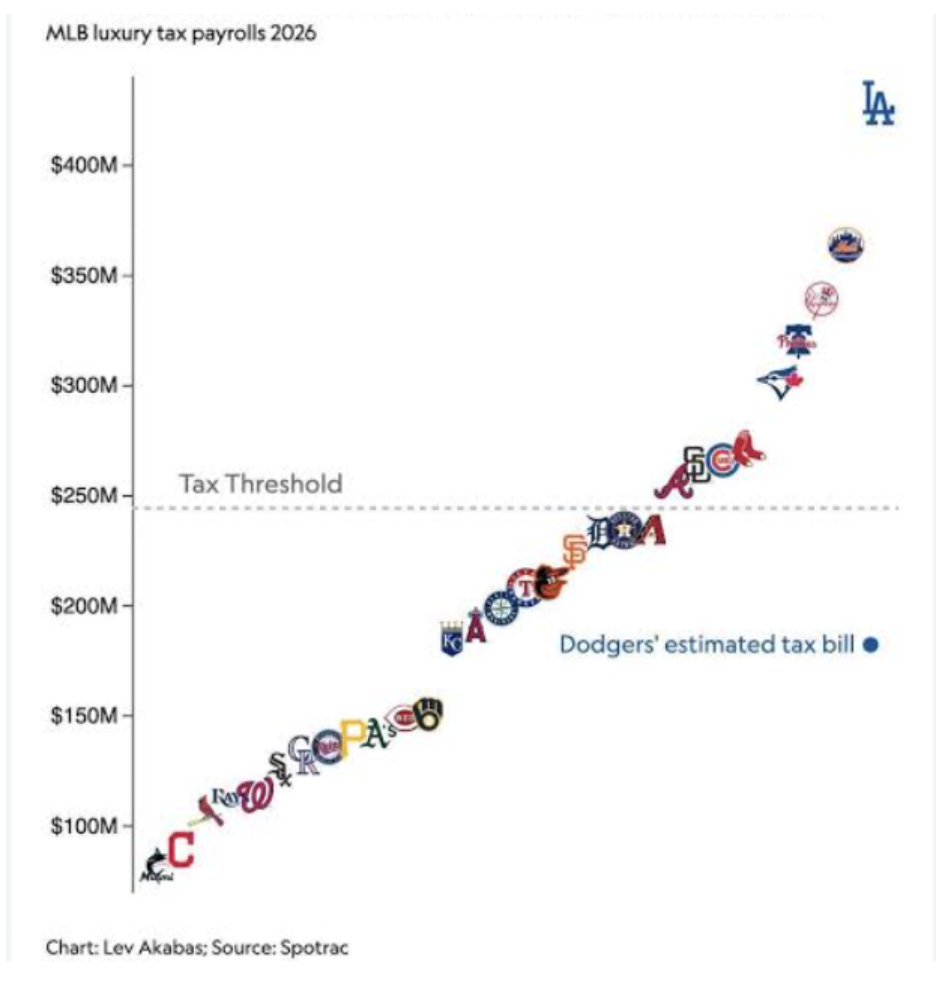
MLB's 2026 luxury tax payrolls highlight the spending gap between teams. (Graphic by Lev Akabas/Sportico; data from Spotrac)
With an Opening Day payroll of approximately $415 million in 2026, the Dodgers have once again shown their willingness to construct their roster by controlling the business side of baseball. Their spending has fueled criticism that the league's lack of a salary cap allows wealthy organizations to dominate the free-agent market, leaving lower-spending teams struggling to compete.
The Dodgers' financial dominance is reflected in their star-studded roster, which features three former MVPs — Shohei Ohtani, Mookie Betts and Freddie Freeman — alongside two Cy Young Award winners, Blake Snell and Tarik Skubal. The five players have earned a combined 10 MVP and Cy Young awards. Even with this roster, the Dodgers fell to the Brewers in five games in this year’s NLCS.
The Milwaukee Brewers entered the postseason with the league's best regular-season record, despite ranking just nineteenth of thirty teams in MLB payrolls at approximately $146 million. Operating in baseball's smallest media market, the Brewers spent a fraction of the Dodgers' payroll while assembling one of the league's most successful teams. Their success challenges the argument that financial resources dictate competitive balance, proving that smaller-market franchises can in fact compete with baseball's flashiest organizations without a salary cap.
This contrast between the Dodgers and Brewers highlights the central question facing MLB's upcoming labor negotiations: Does baseball need a salary cap to maintain competitive balance?
To avoid a lockout, MLB brass and the MLB Players Association must reach a new collective bargaining agreement before the current deal expires on December 1st. Both sides would need to find common ground, potentially through adjustments to revenue sharing, luxury tax regulations, or minimum player salaries. However, since the union has historically been unwilling to agree to a salary cap, reaching a compromise could prove difficult. Without an agreement, owners could initiate a lockout, placing the start of the 2027 season in jeopardy.
Spring training is scheduled to begin on February 19th, with all thirty teams taking the field in Arizona and Florida. The regular season is set to follow with a nationally televised Opening Night matchup on March 24th before another fourteen games on the traditional Opening Day of March 25th. A prolonged lockout could delay spring training and potentially push back the start of the regular season.
A similar situation unfolded in 2022, when labor negotiations postponed Opening Day from March 31st to April 7th. Although the league ultimately conducted its full 162-game schedule that year, another extended lockout could threaten the functionality of a 2027 season if an agreement isn’t reached.
“Obviously, you’d love to see the game be in a good spot and continue to be played,” said Brewers captain and World Series champion Christian Yelich. “I think the game’s in a great spot right now with a lot of people tuned in, a lot of popularity, a lot of great players out there. It would obviously be a shame if we miss time, but we’ll have plenty of time this offseason to talk about it.”
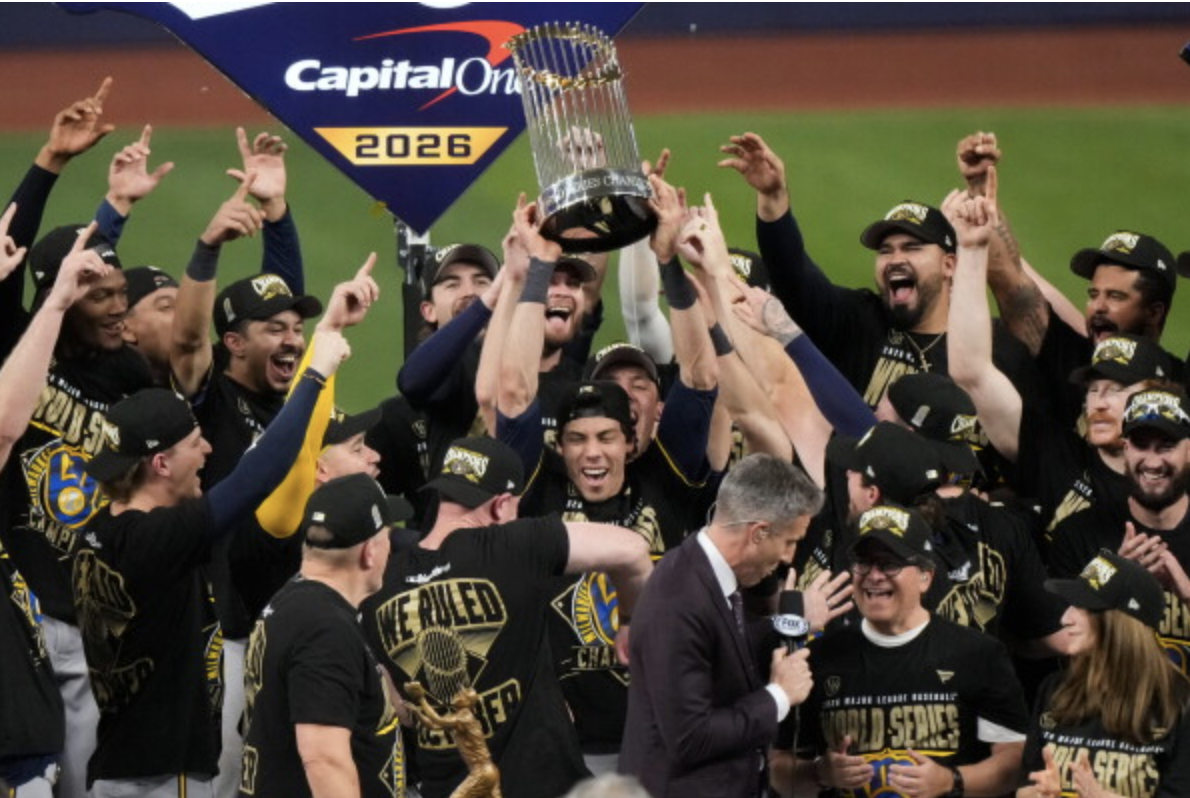
Christian Yelich hoists the World Series trophy alongside his Milwaukee Brewers teammates after capturing the 2026 championship. (AP Photo/Morry Gash)
This potential lockout comes at a time when Major League Baseball is seeing a resurgence in television viewership. FOX averaged 2.35 million viewers per regular-season broadcast in 2026, a 15% increase from the previous year and its highest average since 2021. With baseball attracting its largest audience on the network in five years, a prolonged labor dispute could threaten the league's growing momentum.
More than five decades after MLB's first lockout, the same battle between front office brass and players continues to alter the future of the sport. With record-breaking contracts, growing television audiences, and widening payroll disparities, the stakes have only grown higher. Whether the two sides can reach an agreement remains uncertain, but one thing is clear: Baseball's biggest battle this offseason won't take place on the diamond, but at the negotiating table.
