
Do You Believe in the Chesney Train? The Numbers Behind the Revival of UCLA Football
By Aaron Propst | 19 October 2026
UCLA still had a quarter to play. But first, the Bruins danced.
As “Shout” blared through the speakers before the fourth quarter against Oregon, UCLA joined in a budding ritual. They met the moment with music.
This feeling has been all but familiar to UCLA fans. Just over thirteen months ago, Deshaun Foster was fired following a winless start to the season, losing by an average of more than three touchdowns per game to the opposition of Utah, UNLV, and New Mexico. It wasn’t ridiculous to label the Bruins as the laughing stock of college football, and looking backward offered more comfort than looking ahead.
For some, UCLA’s glory days live in 2022, when Dorian Thompson-Robinson had the Bruins ranked ninth in the AP poll with a 6-0 record.
That team fell to the Ducks in Eugene.
For others, they live in 2014, when Jim Mora’s Bruins opened the season ranked seventh.
That team fell to the Ducks in Westwood.
But perhaps UCLA fans no longer need to look backward.
Starting quarterback Nico Iamaleava left the game before halftime with an apparent knee injury. UCLA turned the ball over three times, including a lost fumble at its own 1-yard line. Still, the Bruins found a way to win, emerging from Autzen with a 17-15 victory after forcing seven turnovers and limiting former five-star quarterback Dylan Raiola to a 2.4 QBR.
Now ranked twelfth in the country with a 5-0 record, the Bruins have accomplished what neither of those teams could: defeat Oregon, claiming their first victory in Eugene since 2004.
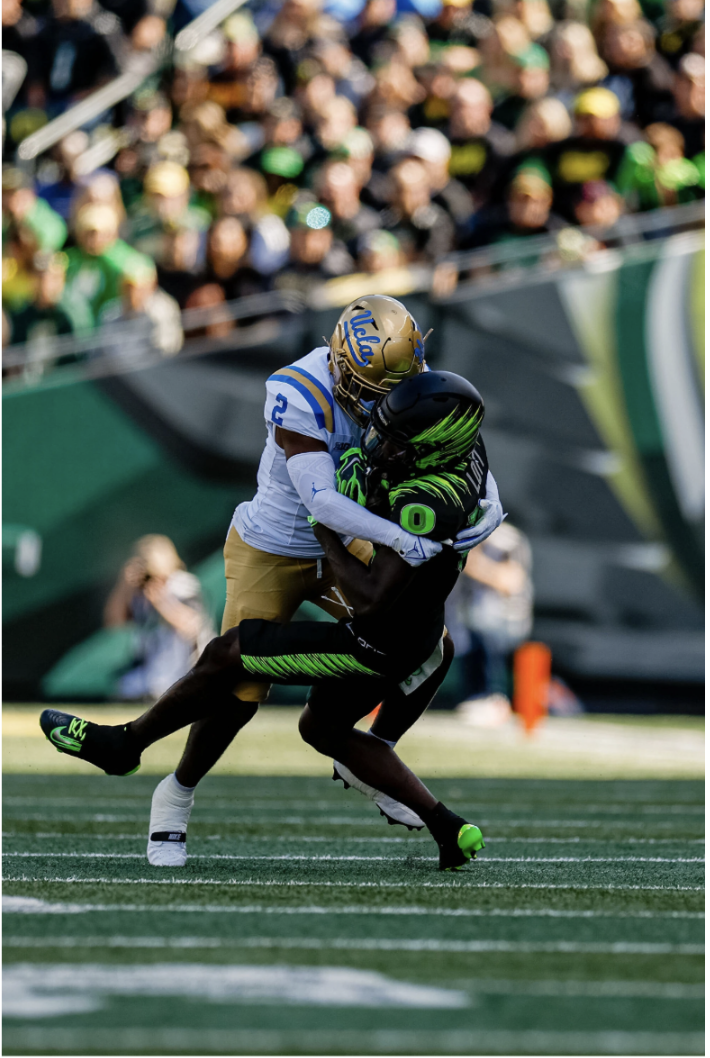
UCLA Bruins cornerback Roderick Pleasant makes a tackle in the first half against the Oregon Ducks in Autzen Stadium. (Oregon Photo Gallery/UCLA Football)
How does a team that struggled so mightily a season ago suddenly find so much success?
Bob Chesney.
Chesney arrived in Westwood with a résumé built on winning. He led Holy Cross to a 44-21 record and five consecutive Patriot League titles before compiling a 21-6 record across two seasons at James Madison. In 2025, he guided the Dukes to their first Sun Belt championship and College Football Playoff appearance, earning conference Coach of the Year honors.
That playoff run ended in a 51-34 first-round loss to Oregon. But the Dukes’ fight offered a glimpse of what Chesney might accomplish with the talent, resources, and support he would have at UCLA.
Chesney’s arrival brought an influx of talent through the transfer portal. UCLA’s incoming 2026 class ranked No. 11 nationally and No. 2 in the Big Ten according to On3, while 247Sports placed it No. 25 nationally and No. 6 in the conference. Those additions, along with the talent he retained from the previous regime, offered an immediate opportunity to reshape the Bruins in his first season.
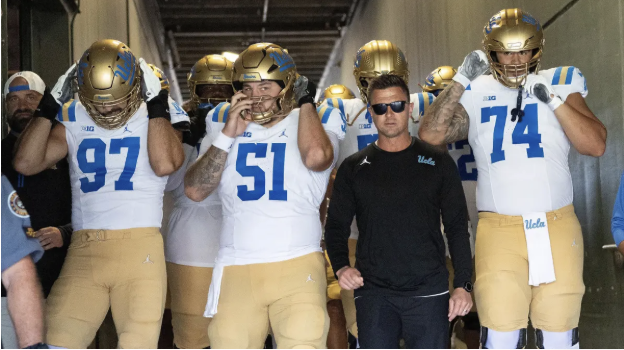
UCLA Bruins Head Coach Bob Chesney leading his team out onto the field to face the Oregon Ducks in Autzen Stadium. (Getty Images)
Now, that infusion of talent is on display in a dynamic three-headed rushing attack. Wayne Knight has broken out with 548 rushing yards and 10 touchdowns, averaging 7.7 yards per carry. Anthony Woods follows with 308 yards and four scores at 6.8 yards per attempt, while Jaivian Thomas adds 163 yards and three touchdowns. Together, the trio has amassed 1,019 yards and 17 touchdowns, giving opponents plenty to think about regardless of who lines up in the backfield.
That talent also carries a multimillion-dollar valuation. The NIL Standard estimates UCLA’s 2026 football roster’s NIL value at $25.4 million, including $13.9 million attributed to incoming transfers.
Moving forward in the season, the Bruins avoid both Ohio State and Indiana, with remaining games featuring matchups against Wisconsin, Michigan State, Nevada, Minnesota, Illinois, Michigan, and a home finale against USC, which is currently ranked nineteenth in the AP poll. This remaining strength of schedule ranks them seventeenth out of the eighteen Big Ten teams.
"What drives us is our desire to get better every single day and for our guys to be, again, moving our program from good towards great and be better today than we were yesterday. That's what drives this entire program and this entire organization, everybody in this building,” said Chesney.
“That's ultimately what I want them to focus on. Don't worry about the outside. That really can't help us or hurt us, realistically. It's more of an emotional thing than it is anything else. How do we just focus on what we got to do and remove the emotion from the motion?"
With Iamaleava sidelined, Ty Dieffenbach steps into the starting role with limited action this season but FCS experience from a year ago. After stepping onto the field versus Oregon last week, he completed three of his six passes for 43 yards and a touchdown. In his 2025 campaign at Cal Poly, Dieffenbach threw for 1,305 yards, nine touchdowns and nine interceptions while completing 56.8% of his passes. He also added 321 rushing yards and four scores, bringing another running threat to an offense already deep in the backfield.
"You're going to have guys that can't make it the whole season, and our job has to be to be ready,” said Chesney. “That's what the message was the other day. If you think you're a three, get ready. You might be a two. If you think you're a two, get ready. You might be a one. And when that light shines on you — I've been saying it from the beginning of time here — when that light shines on you, you're either exposed or revealed. So let's make sure that you're revealed."
Dieffenbach now inherits the task of keeping that momentum alive. A forgiving schedule offers opportunity, but UCLA must still turn its early breakthrough into a season worth remembering. For Chesney, that means translating a rebuilt roster and renewed belief into sustained success.
The Bruins still have plenty of football to play. But for fans accustomed to reminiscing on the past, this team has given them a reason to look ahead - and, between quarters, a reason to dance.
