
“Success Looks Like Winning”: Why Bob Chesney is UCLA’s Big Ten Hail Mary
By Sophie Beck | 16 December, 2025
After a problematic 3-9 overall record in 2025 and a mid-season coaching change, UCLA’s football program was under heavy pressure to secure a transformative hire and turn the historic program around. The team, struggling in its first two seasons in the Big Ten, had fired Deshaun Foster, former UCLA football player and Head Coach, after an 0-3 start. Interim Head Coach Tim Skipper was then left to navigate the rest of UCLA’s tough schedule. Although the program saw a promising three-game win streak against Penn State, Michigan State, and Maryland, a late-season skid ultimately resulted in yet another disappointing finish in 2025. After an emotional loss against long-standing rival USC, UCLA fans were waiting in anticipation for the announcement of the head coach of the future.
On December 6th, the wait was finally over. Bob Chesney, former Head Football Coach of James Madison University, was announced the new Head Football Coach for UCLA. Bob Chesney becomes the 20th Head Coach in UCLA history, and, remarkably, the first sitting Head Coach the university has hired since 1971. He was formally introduced at a press conference held on UCLA’s campus, explaining right off the bat that “Success looks like winning. That’s what it looks like on a day-to-day basis.” This high-risk gamble on a program builder from the East Coast, was not the predicted hire for this UCLA team. However, this choice is a defining pivot for UCLA’s Big Ten era and proves UCLA’s desire for discipline over hiring a household name.
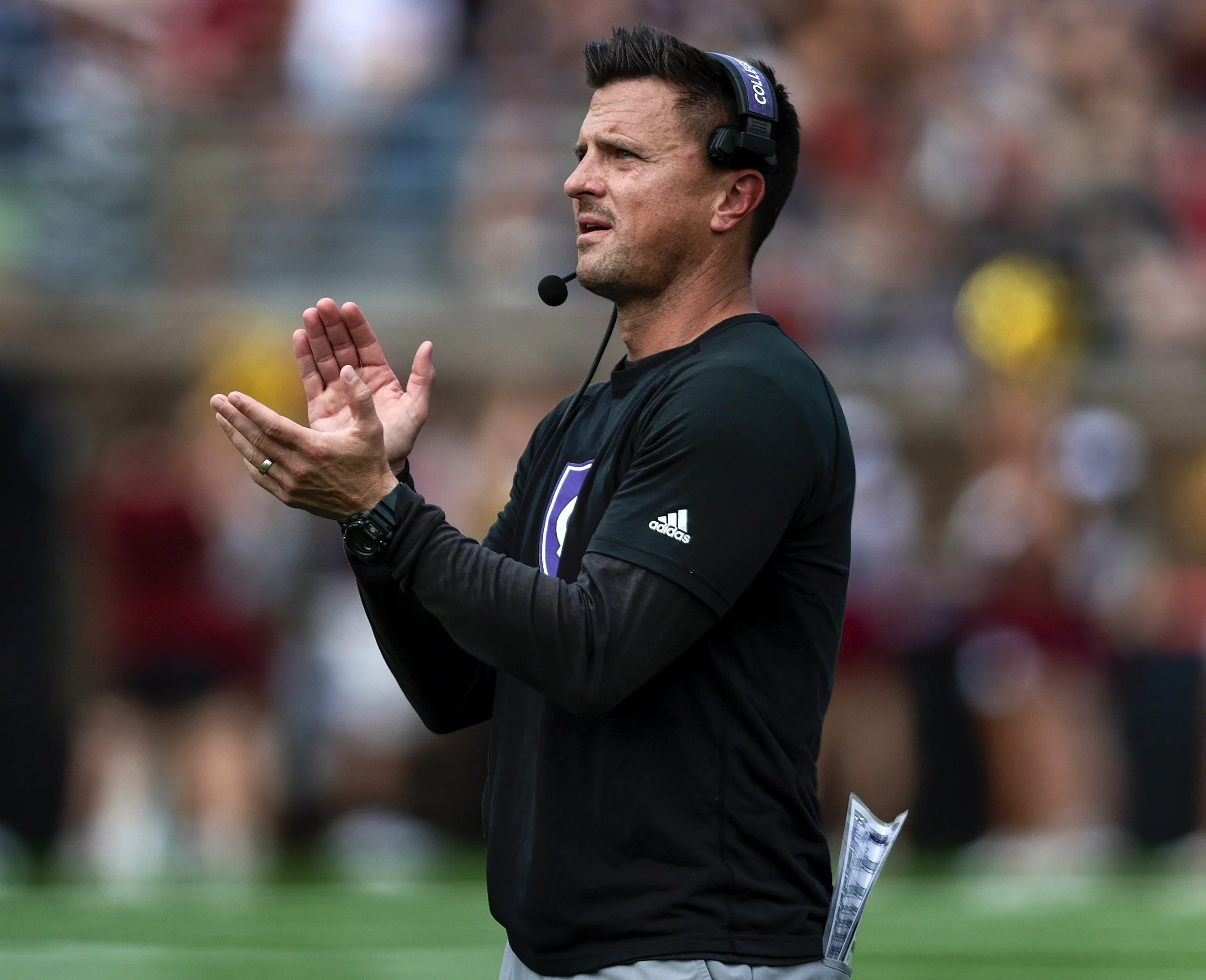
Bob Chesney on the Holy Cross sideline, the Bruins’ Head Coach’s home prior to James Madison. (The Boston Globe)
Chesney’s Background
Bob Chesney’s resume displays a promising blueprint for success. A native of Kulpmont Pennsylvania, Chesney graduated from Dickinson College and was a four-year letterman as a defensive back. After graduating, he began his coaching career as Assistant Coach and Defensive Coordinator at different institutions including Norwich University, Delaware Valley College, King’s College, and Johns Hopkins. Chesney’s successful career kickstarted when he became the Head Coach of Salve Regina, which served as the foundation for his transformative coaching philosophy that centers on building championship culture from the ground up. Coming into Salve Regina, Chesney was working with a team that had suffered eight consecutive losing seasons. However, this was not an intimidating task for Chesney. He led them to three straight winning campaigns and an ECAC North-West Bowl Championship in 2011 with an overall record of 23-9 in three seasons.
After his successful career at Salve Regina, he went to coach at Assumption and found winning success there as well. At Assumption, he was named Northeast-10 Conference Coach of the Year twice. Bob Chesney’s tenure at the College of Holy Cross was the period where his reputation as an elite program builder at the Division I level was cemented. He coached the Crusaders in the FCS Patriot league for six seasons, from 2018 to 2023, transforming a struggling team into an absolute powerhouse. In his most recent and crucial head coaching position at James Madison, Chesney quickly established the Dukes' force at the FBS level. He took over after former coach Curt Cignetti left for Indiana, where the team was gutted by the transfer portal, yet he still managed to lead the team to a 9-4 record in his first year. This year was the best season in program history, as he led the team to the Sun Belt Conference Championship, an appearance in the College Football Playoff, and earned 2024 VaSID Coach of the Year. Chesney brings an overall head coaching record of 132-51 to the UCLA football program, along with a philosophy centered on winning and building championship culture within struggling teams.
The State of the Program: What Bob Chesney Is Inheriting at UCLA
The statistics from this year's 2025 season paints an unpromising outcome for next season. With a 3-9 overall record, a 3-6 mark in the Big Ten, and a crippling five-game losing streak to end the year, Chesney is walking into a program under harsh criticism and uncertainty. According to UCLA’s 2025 Football Cumulative Statistics, the defense, which gave up 33.4 points per game, was bashed repeatedly by the press, while the offense failed to score more than 19 points per game. This tumultuous year saw the early dismissal of former Head Coach Deshaun Foster, leaving interim Tim Skipper to navigate the rest of the chaotic season. While Skipper managed to slightly stabilize the team, leading to key wins against Penn State and Michigan State, the underlying issues like poor discipline and inconsistent performances remained visible. The most apparent problem was UCLA’s Big Ten schedule, where the Bruins were outclassed by the conference’s heavyweights, losing to No. 1 Ohio State and No. 2 Indiana by a combined score of 104-16. The search committee, backed by Chancellor Julio Frenk and other alumni, were “laser focused on landing a program builder who will represent UCLA the right way and who has built a winning expectation,” said Athletic Director Martin Jarmond. The overall consensus was that they didn’t need a specific coach to represent UCLA; rather, they needed someone that showcased the ability to win, and that person is Bob Chesney.
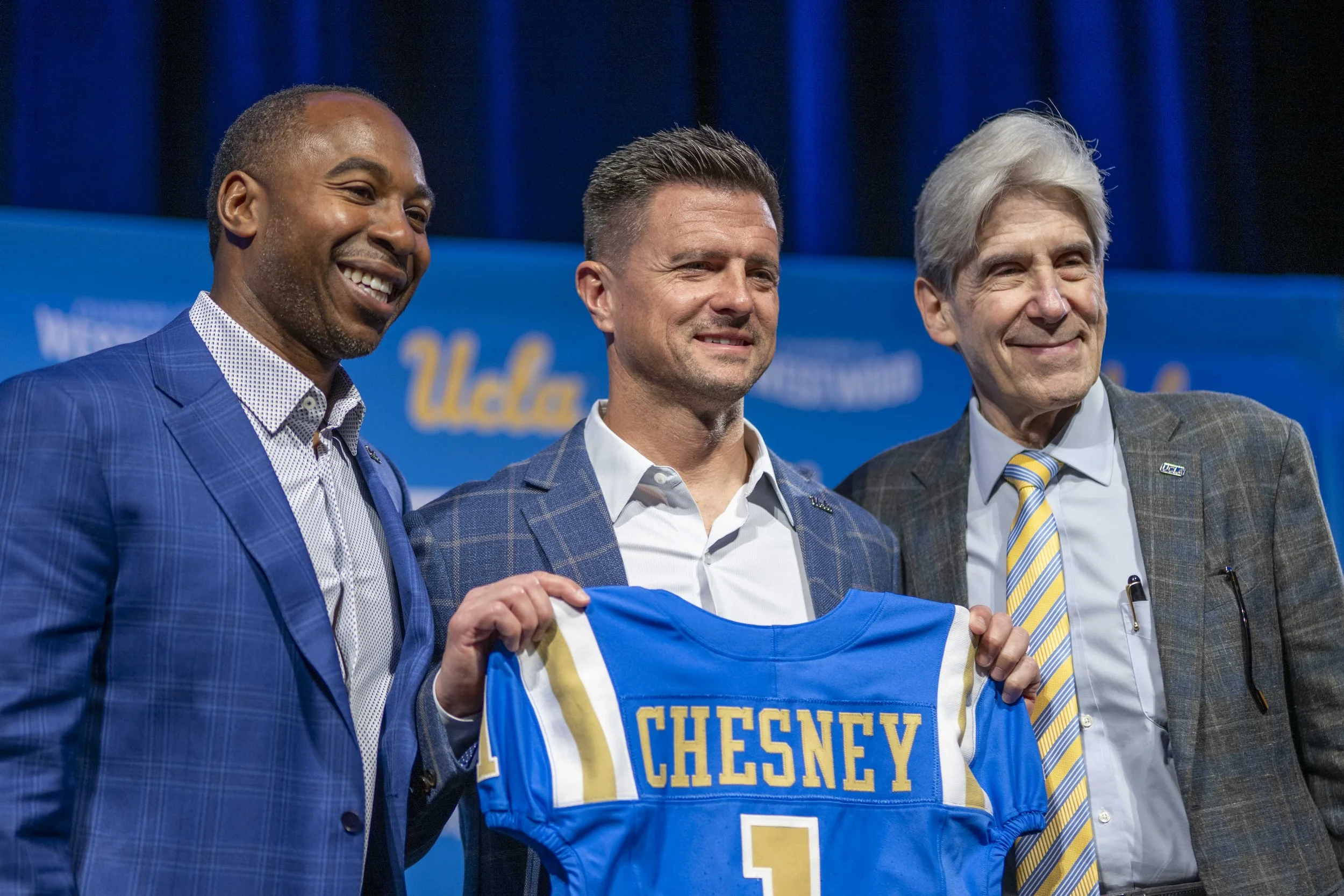
Martin Jarmond, Bob Chesney and Julio Frenk at the introductory press conference. (Aidan Sun/Assistant Photo editor)
The Press Conference and Chesney’s Mission Statement
Chesney’s introductory press conference on December 9, 2025, was crucial in establishing the program’s newfound “alignment,” a word that Athletic Director Martin Jarmond emphasized the most during the coaching search. Not only finding a coach to align with the team, but also the core values that UCLA stands for as one of the top universities in the country. Chesney said all the things UCLA fans and players wanted to hear. Chesney stated, “I see zero reason why we cannot be competing for a championship,” and then went on to escalate his goals for the team, saying he wanted UCLA to be “the premier program in this state,” a direct shot at school rival, USC.
Chancellor Julio Frenk and Martin Jarmond reiterated their complete support and commitment to this once-prominent football program, guaranteeing the resources necessary to compete with the Big Ten’s elite. Martin Jarmond said, “Leadership is the best way to transform a program and I think we found a leader in Bob. It’s like buying a stock that’s down with a lot of potential, and I view the football program like that.” Buying into a program, coaches, and players is necessary to fostering a championship mindset. In the press conference, Chesney described it best as being more than just an understanding, but more so a “care and willingness to work together.” For the first time in a long time, the UCLA administration appears fully united behind the transformation of this UCLA football program and this newfound ambition that has been catalyzed by Bob Chesney.
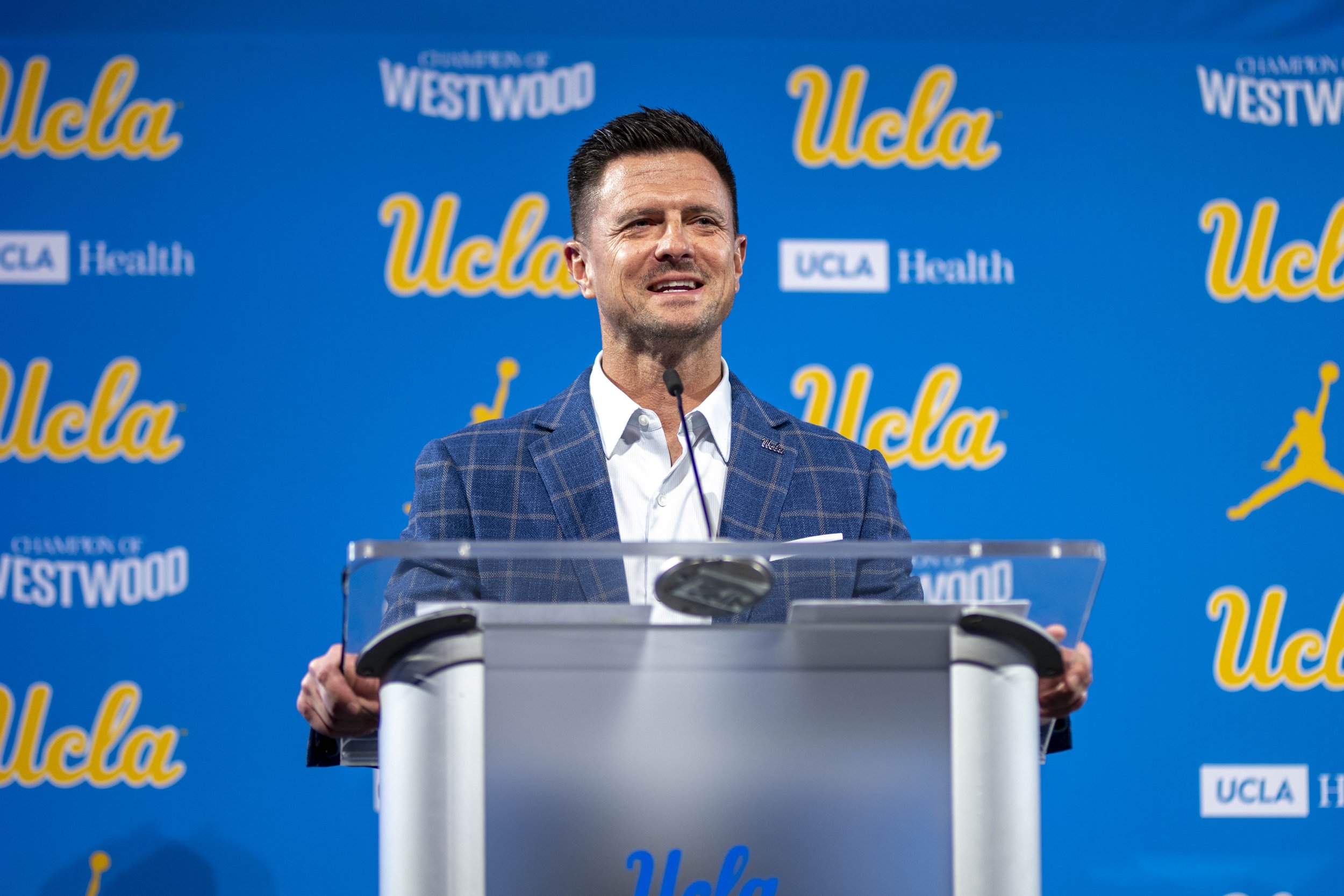
Bob Chesney, all smiles, at his introductory press conference. (Ross Turteltaub)
Transfer Portal, Roster Reconstruction, and Coaching Changes
The most pressing issue that Bob Chesney will face is the roster reconstruction and coaching staff changes, alongside the volatile environment of the transfer portal and this new territory coaches need to navigate. After a 3-9 record, the program is currently facing a substantial talent deficit and overall stability that demands intervention. The 2025 season’s instability triggered many talented players to leave and enter the transfer portal. Key defensive backs, including Scooter Jackson and Cole Martin, announced their plans to enter the transfer portal. These two players alone accounted for three of UCLA’s six interceptions during the season. These departures, alongside the transfer of tight end Jack Pedersen, mean UCLA is entering the 2026 season without several key players.
This recruiting situation and roster reconstruction is an urgent problem that Bob Chesney needs to face. The program saw its already low-ranked 2026 recruiting class suffer multiple de-commitments, which will make UCLA reliant on the transfer portal to quickly find Big Ten-caliber talent. In his press conference, Chesney made it known that he wants to hire “people that have deep ties here to the west coast, that certainly understand the players within this environment, understand the areas and understand the power players in it.” Chesney acknowledges his lack of West Coast experience and has promised that his staff will be from the West. Chesney has brought in his own James Madison Offensive Coordinator, Dean Kennedy, for the same role at UCLA. Although he has East Coast roots, Kennedy coached with Chesney for four seasons and gained great experience from his time at Florida and Mississippi State. UCLA is also set to hire Darrick Yray from Florida State as the General Manager of Personnel, with his experience at Fresno State and Oregon State aligning with Chesney’s goal of establishing deep local ties. The program is also reportedly retaining Marshawn Friloux, the Senior Director of Football Recruiting Operations, at least through January. Chesney and the hiring staff will continue to hunt for coaches and prioritize local coaches and players, believing that it will make for a better recruiting process and connection.
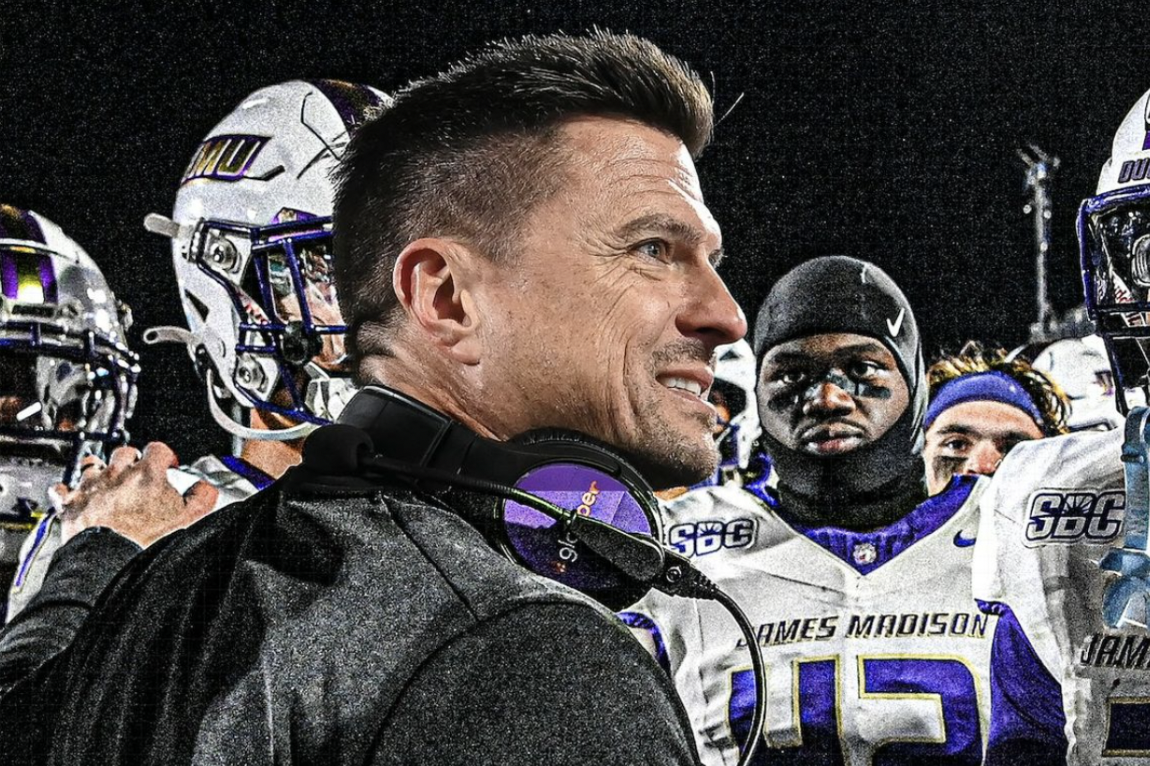
Chesney, Head Coach of the James Madison Dukes. (James Madison University Athletics)
Dual Commitment: Defining Integrity
One of the most defining actions of Chesney’s transition – one which showed his true character and integrity as a person – was his decision to coach James Madision through their College Football Playoff game against Oregon. This commitment, which is supported by Martin Jarmond and Chancellor Julio Frenk, delays his ability to function fully as UCLA’s Head Coach. Chesney explained his reasoning behind this decision in his recent press conference, saying, “I think it’s, again, empathy. I would not want my head coach walking out on us in the middle of a mission that we’re still committed to and finishing.” Chesney’s dual commitment speaks volumes about his leadership and philosophy, which was exactly what the hiring committee was looking for. Martin Jarmond fully encapsulated who Chesney is as a person, saying, “He’s a leader, a consensus builder and a developer of young men, and I’m thrilled to welcome him and his family to Westwood.” Chesney will manage these two roles by splitting it up the best he can, with JMU’s practices during the day and handling UCLA’s foundational work via meetings during the evenings. This commitment instantly reestablishes the high expectations and accountability that Chesney is bringing to Westwood.
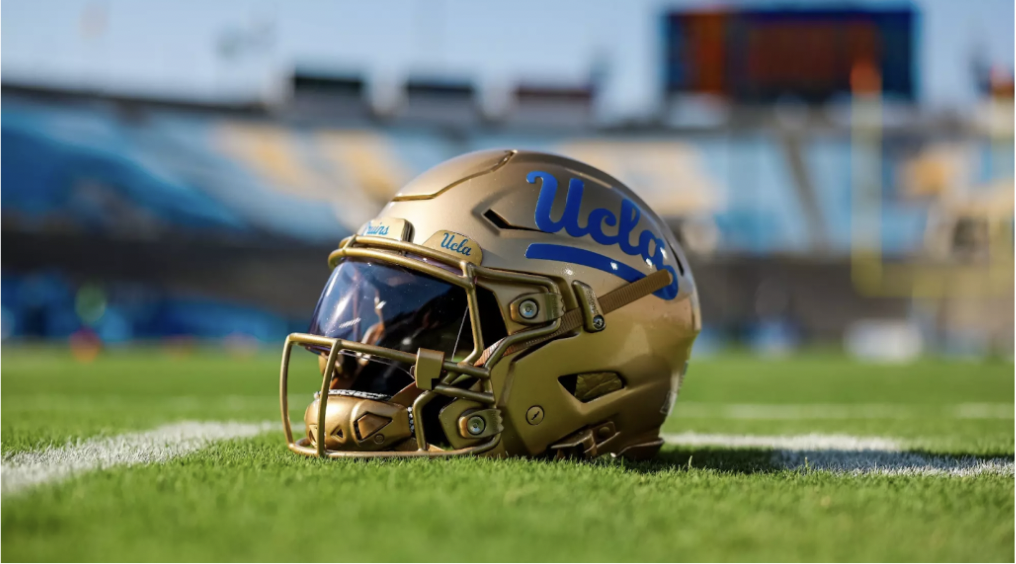
UCLA, Coach Chesney’s new home. (UCLA Athletics)
This new hire for UCLA Football is very promising. After a disappointing season, UCLA players and fans are more than ready for a significant change. However, this change will not be judged on the 2026 season’s final record, but the trajectory of the program over the next five years. Given the massive changes that have happened just this season, patience will be required. Yet, for the first time in a long time, there is genuine hope and excitement surrounding UCLA Football. This hope stems from knowing that Chesney is a proven program builder who has notoriously turned losing teams into champions, like he said, “I see zero reason why we cannot be competing for a championship.” The immediate task to hire a West Coast-savvy staff and find new players in the transfer portal is a tall order, but there is no doubt that Chesney can execute it. The hopeful new era for the Bruins has officially begun.
